Manual handling around a labelling line can look small until it slows product flow, increases rework, or keeps operators tied to repetitive tasks.
Automated product handling helps manufacturers improve line flow, label accuracy, inspection, rejection, and ROI by connecting conveyors, labellers, vision checks, and support around the real production bottleneck.
In this article:
- How spacing, orientation, inspection, and rejection affect labour, waste, throughput, and downtime.
- Why conveyor systems, product handling, and vision inspection can reduce manual intervention around labelling.
- How to assess ROI using labour, waste, downtime, and payback period inputs.
- Where ALS Identify supports the wider line through integration, maintenance, and practical after-sales service.
Why Automated Product Handling Pays Back Faster Than Expected
Upgrading pre- and post-labelling product handling is often seen as a cost. But for many manufacturers, it’s one of the fastest-returning investments they can make.
By automating product spacing, orientation, inspection, and rejection, food, beverage, and pharmaceutical production managers can unlock measurable gains in speed, quality, and labour efficiency, often seeing payback in months, not years. When you look beyond the initial price tag, total cost of ownership tells a different story.
At ALS Identify, we design and build solutions that deliver long-term value while solving today’s bottlenecks. Here’s how to assess the real ROI of automated product handling.
What Does Manual Labelling Actually Cost Per Year?
Manual tasks like product orientation, spacing, and reject removal require constant operator attention. Adding the right conveyor systems around those steps can help keep product flow steady and reduce manual intervention.
The hidden costs of manual handling around labelling – including labour inefficiencies, errors, and rework – add up quickly across shifts.
Labour Savings Per Shift
Automating these steps allows you to:
- Reduce the number of operators required per line
- Reassign operators to higher-value activities such as changeover management or quality analysis
- Minimise overtime costs caused by slow or unpredictable runs
Example: One ALS Identify customer reduced operator involvement by 2 hours per shift, saving the equivalent of €35,000 per year in labour costs.
Rework and Waste Costs
Every incorrectly labelled product represents wasted packaging, product, and labour. Machine vision inspection systems identify defects and barcode verification failures instantly, and vision systems can help remove non-compliant products before more resources are invested.
- Less scrap
- Fewer rework runs
- Lower disposal costs
Example: A beverage manufacturer reduced labelling errors by 60% in the first three months after installation.
How Automation Increases Throughput on Labelling Lines
Bottlenecks in spacing, orientation, or rejection processes slow the whole line. Automated product handling systems keep the labeller running at its rated speed without unplanned stops.
Output Gains Per Shift
- More units per shift
- Faster changeovers
- Increased flexibility for seasonal, promotional, or multi-SKU runs
Operational Flexibility Across SKUs
Automated spacing and rejection systems can reduce changeover friction across product variants, making it easier to run more SKUs without putting as much pressure on operators.
Example: A pharma producer increased line output by 18% without adding shifts, simply by installing automated spacing and rejection systems.
How Does Labelling Automation Protect Compliance and Brand Reputation?
In regulated industries, a single mislabelled product can trigger recalls, fines, or reputational damage. The right labelling systems and inline checks help labels stay correctly applied, clearly printed, and readable.
Inline vision inspection and accurate data capture support traceability by checking that every label is:
- Correctly applied
- Clearly printed
- Fully compliant with barcode readability requirements
Machine Vision and Barcode Verification
Machine vision and barcode verification give operators a way to check label presence, print quality, and code readability before the product leaves the line.
Track and Trace in Regulated Industries
That kind of data integrity matters most in pharma and food, where labelling errors can create audit risk, rework, delayed shipments, or recall exposure.
Example: One ALS Identify project prevented a potential recall by detecting a batch-wide print quality issue before shipment.
How to Calculate the ROI of a Labelling Line Upgrade
Here’s a simplified ROI calculation you can adapt to your own facility:
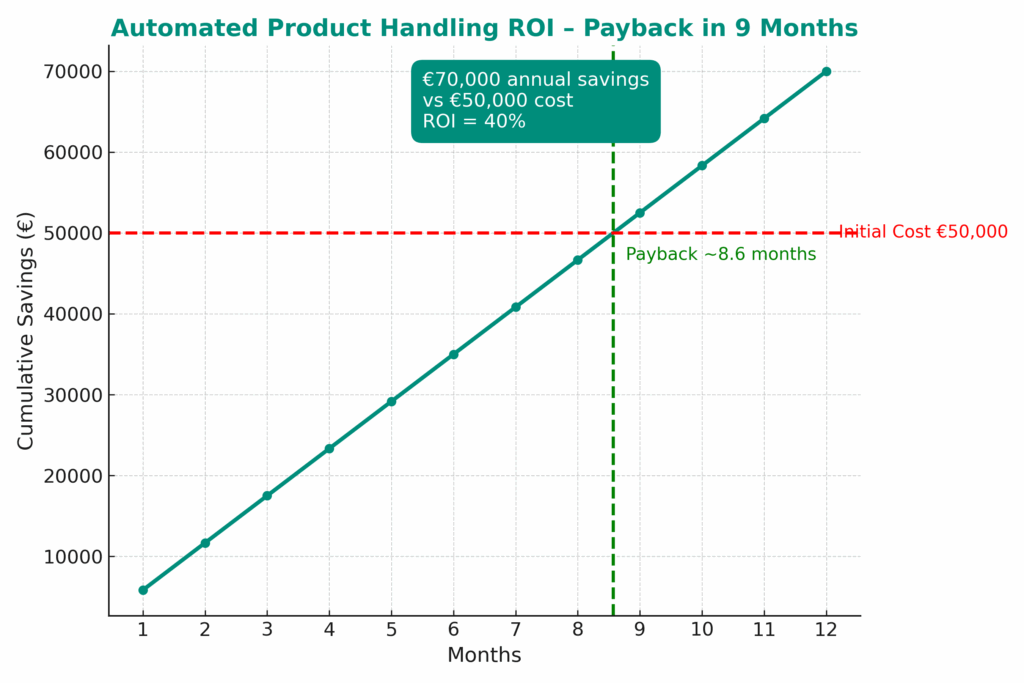
A closer look at pre and post-labelling product handling shows why the ROI can be strong: small reductions in waste, labour, and downtime compound quickly across shifts.
Annual savings from automation:
- Labour reduction: €35,000
- Waste reduction: €15,000
- Downtime reduction: €20,000
Total savings per year: €70,000
If your automated product handling upgrade costs €50,000, that’s a payback period of just 9 months, with continued savings every year after.
Frequently Asked Questions About ROI in Automated Product Handling
What does ROI mean in the context of production line automation?
ROI, or return on investment, measures how quickly the savings generated by an automation upgrade begin to offset its upfront cost. In a labelling line context, those savings usually come from reduced manual handling, less waste, fewer downtime incidents and lower rework costs.
How quickly can automated product handling pay for itself?
Payback periods vary depending on line speed, labour costs, downtime, waste and the scope of the upgrade. The example in this article shows a €50,000 system returning its full cost in around nine months through combined savings on labour, waste and downtime.
Does automated product handling only benefit large production facilities?
No. The financial case depends on the cost of the current bottleneck, not only the size of the facility. Repeated manual handling, labelling errors, rework or downtime can create a business case for automation on smaller and larger lines.
Can vision inspection systems reduce recall risk?
Yes, when they are specified and integrated correctly. Inline vision inspection can check label presence, print quality and code readability before product leaves the line, helping teams catch issues earlier and reduce the risk of non-compliant batches reaching customers.
Why Work With ALS Identify?
ALS Identify can also support installed systems with preventative maintenance services to help protect uptime and keep equipment performing reliably.
- Guaranteed Irish – Local design, build, and service support for faster turnaround and minimal downtime.
- Custom-built – Every system is engineered for your product range, speed targets, and factory layout.
- Integration expertise – We ensure seamless compatibility with your existing labellers, conveyors, and controls.
The ROI of automated product handling isn’t just in speed, it’s in labour savings, waste reduction, compliance protection, and increased capacity. For many manufacturers, the numbers add up to a faster, more profitable operation.
Want to calculate your own ROI?
Download our free Buyer’s Checklist and discover exactly what to consider when planning your next automation upgrade.